How to Read a Peptide Certificate of Analysis (COA)
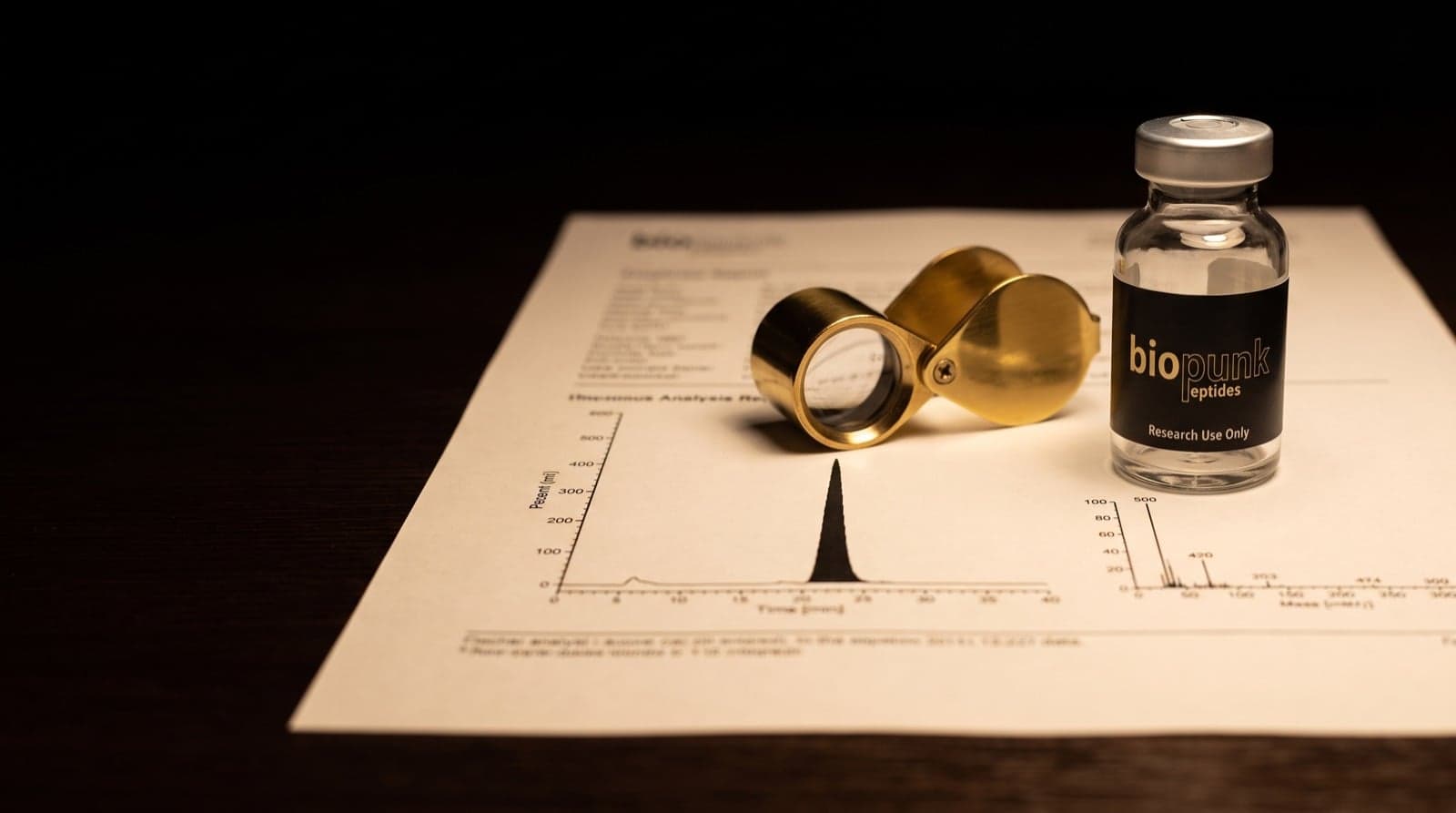
A Certificate of Analysis, or COA, is the lab report for one batch of a product. For a peptide, it tells you what the batch was tested for, how, and what the results were.
Most COAs look dense the first time you see one, but they’re easier than they look. This is how to read a COA for peptides, section by section. Once you know what each part measures, you can get through one in a couple of minutes.
For questions about a specific product or order, see our FAQ.
What’s on a peptide COA
Layouts differ between labs, but most peptide COAs cover the same ground:
- Identification: the product name, the batch or lot number, and the date of analysis
- Appearance: usually a line such as “white powder” for a lyophilized peptide
- Purity by HPLC: a percentage, often with the chromatogram attached
- Identity by mass spectrometry: the molecular weight that was measured
- Other results: some COAs also report peptide content, counter-ion content or water content
The purity and identity results are the ones to understand first.
HPLC purity: what it measures
HPLC stands for high-performance liquid chromatography. It separates the sample into its components, and a detector draws each one as a peak on a chart called a chromatogram.
Bachem describes it like this: purity is usually assessed by UV detection at 210 to 220 nm, where the area of the main peak compared with the total area of all the peaks reflects the peptide purity.
So when a COA says 98% purity by HPLC, it means the main peak takes up 98% of the peak area the detector picked up. The other 2% is other material the detector picked up, such as peptide impurities.
It doesn’t say what share of the powder in the vial is peptide. That’s a separate number, covered below.
Mass spectrometry: is it the right molecule?
HPLC tells you how clean the sample is. Mass spectrometry, or mass spec, tells you what it is. According to Bachem, the molecular weight is determined by mass spectrometry.
On a COA, look for the measured mass next to the expected (theoretical) mass for that peptide. If they match, that’s strong evidence the batch contains the right molecule. If you work in molar units, the molecular weight is also the number you need for conversions, and our molarity converter does that arithmetic for you.
A matching mass confirms identity, but it isn’t a purity result on its own.
HPLC purity vs peptide content
This is the easiest part to mix up, and it’s where “HPLC purity vs assay” questions come from.
A lyophilized peptide isn’t 100% peptide by weight. Bachem explains that the gross weight of a peptide sample includes the peptide, counter-ions and adhered water. Counter-ions are usually acetate or trifluoroacetate (TFA), bound to the peptide as a salt.
That’s why some COAs report a second number, the net peptide content. Bachem defines it as the fraction of peptidic material relative to counter-ions and residual water.
The two numbers answer different questions:
| Result | The question it answers |
|---|---|
| HPLC purity | Of the peptide material, how much is the target peptide? |
| Net peptide content | Of the total powder weight, how much is peptide? |
Bachem gives an example of a sample with 98.7% HPLC purity and 85% net peptide content. Both numbers can be correct at the same time.
A quick COA checklist
- Does the batch number match your vial? A COA only describes the batch it was written for.
- Is the date there? You want to know when the analysis was done.
- Is the lab named? A COA should say who ran the tests.
- Is the method stated? A purity figure means more when you know it came from HPLC, and under what conditions.
- Is the chromatogram attached? The chart lets you see the main peak and anything around it.
- Does the measured mass match the expected mass? That’s your identity check.
Common questions
What is a peptide COA?
A lab report for one specific batch of a peptide. It lists the tests that were run on that batch and the results.
What is HPLC purity?
The share of the peak area on an HPLC chromatogram that belongs to the target peptide. It measures how clean the peptide material is, not how much of the powder is peptide.
What’s the difference between HPLC purity and assay?
Purity compares the target peptide with other peptide material. Content, often reported as net peptide content, compares all the peptide material with everything else in the powder, like counter-ions and water.
Is 98% purity good for peptides?
It depends on what the research needs. What you can say is what it means: 98% of the HPLC peak area is the target peptide.
For Research Use Only. Not for use in diagnostic procedures. All Biopunk Peptides products are for laboratory research use only. They are not for human or animal consumption.
Related posts
What Does “Research Use Only” Mean on Peptides?
What the Research Use Only label on a peptide means, what research use covers, what it rules out, and why we don’t answer some questions.
Do Peptides Expire? The Shelf Life of Lyophilized Peptides
Yes, peptides degrade over time. Here’s what decides the shelf life of a dry, lyophilized peptide, and how to read the dates on a vial.
How to Store Lyophilized Peptides
Fridge, freezer or room temperature? A plain guide to storing dry, lyophilized research peptides, and why light, moisture and air matter.