OVAGE
RUO
20mg
pep-OVA-20mg-us
Ovagen
$75.34Out of stock
Biopunk supplies research-grade compounds for laboratory research. Our products are not for human or animal consumption and are not intended to diagnose, treat, cure, or prevent any disease.
Loading product…
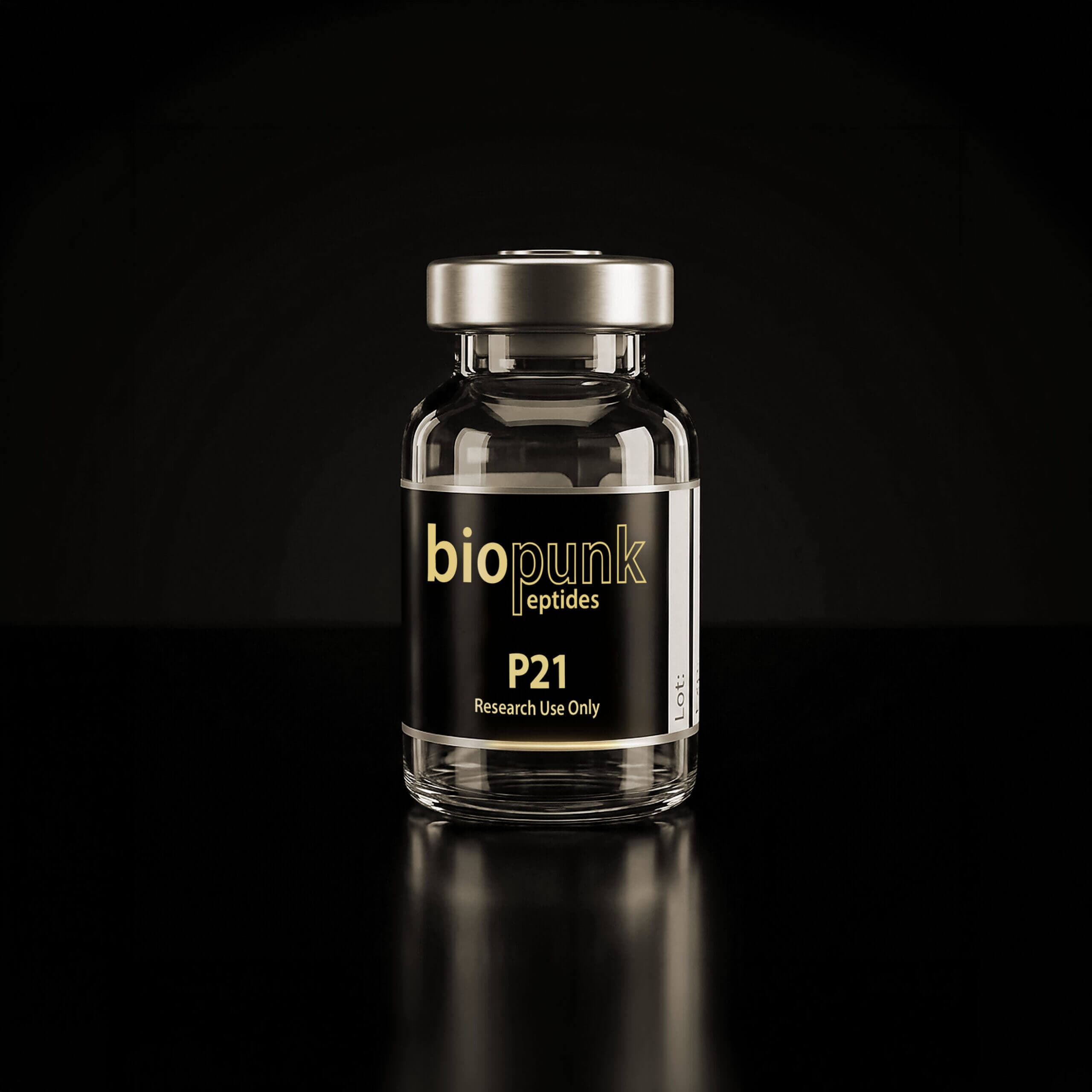
pep-P21
P21 is a synthetic tetra-peptide mimetic derived by epitope mapping from the biologically active region of human ciliary neurotrophic factor (CNTF). Kazim & Iqbal (2016), Baazaoui & Iqbal (2017), and Mottolese et al. (2024) have characterized P021 in cell-culture and rodent neuroscience research models, tracking neurogenesis and neurotrophic-pathway markers including BDNF gene expression. Lyophilized powder, research-grade purity. For Research Use Only. Not for human consumption.
Strength · 2 variants
Manufactured in · 2 sources
| Strength | USA | China |
|---|---|---|
| 5mg | $179.84Out of stockView | $163.49Out of stockView |
| 10mg | $228.79Out of stockView | $207.99Out of stockView |
For laboratory research use only · Not for human or veterinary use.
Description
A synthetic small-molecule peptide mimetic (also written as Peptide 021 or P021) derived by epitope mapping from the biologically active region of human ciliary neurotrophic factor (CNTF).
P21 is a synthetic tetra-peptide identified through epitope mapping of the biologically active region of human ciliary neurotrophic factor (CNTF). The research design attaches an adamantylated glycine at the C-terminus to increase blood-brain barrier penetration and resistance to exopeptidase degradation. It is not to be confused with the p21 tumor-suppressor protein — those share nothing beyond the numeric label. Sold as lyophilized powder, research-grade purity.
Kazim & Iqbal (2016) reviewed neurotrophic-factor small-molecule mimetics and characterized P021 as a compound that has been studied in in-vitro and in-vivo research models for its interactions with the leukemia inhibitory factor (LIF) signaling pathway and brain-derived neurotrophic factor (BDNF) gene expression. Baazaoui & Iqbal (2017) examined chronic dietary intake of P021 in a 3xTg-AD transgenic mouse model, tracking dendritic and synaptic markers, neurogenesis indices, and cognitive-behavior measurements across the observation window. Mottolese et al. (2024) studied P021 in an in vitro (SH-CDKL5-KO cells) and in vivo (Cdkl5 KO mouse) model of CDKL5 deficiency disorder, characterizing neuronal proliferation, survival, and GSK3β pathway markers.
For Research Use Only. Not for human consumption.
Specifications
Lab reports
We independently test selected batches and publish those reports. Not every batch has one, and this strength and origin does not have a published report right now. You can read how certificates of analysis work, or browse every report we have published.
Shipping & Storage
Shipping
Orders ship within 24 hours. Delivered via USPS Priority or standard FedEx unless expedited shipping is selected at checkout. Tracking is emailed on dispatch and mirrored in your account.
In-transit handling
Lyophilized vials are shelf-stable and ship at ambient temperature. Storage in our warehouse is cooled; shipment does not require refrigeration.
Long-term storage
Lyophilized vials are shelf-stable at ambient temperature; refrigeration (2–8°C) extends shelf life. Where a published Certificate of Analysis exists for your strength and origin, it is on the COA tab. Not for human or animal consumption.
Returns
Because these are research-grade biologics, we cannot accept returns on opened vials. Damaged-in-transit shipments are replaced at no cost within 7 days of delivery.
Frequently asked
We independently test selected batches at a third-party lab and publish those certificates of analysis. Not every batch has one. The COA tab on each product shows whether the strength and origin you picked has a published report.
Related