OVAGE
RUO
20mg
pep-OVA-20mg-us
Ovagen
$75.34Out of stock
Loading product…
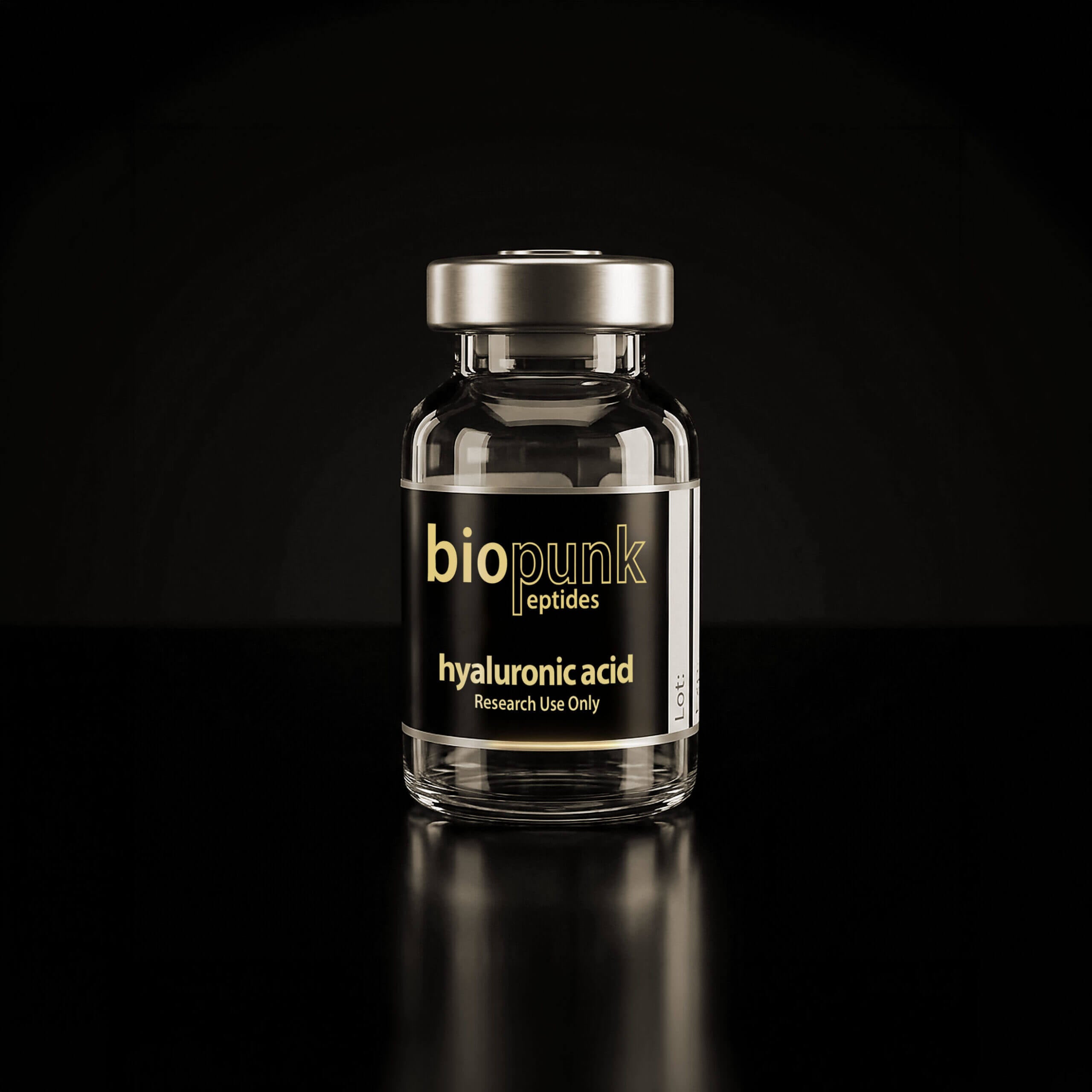
pep-HYA-5mg-us
CAS 9004-61-9
Hyaluronic acid (hyaluronan) is a linear glycosaminoglycan with a documented water-binding capacity, synthesized at the cell membrane and studied for its role in extracellular-matrix organization. Fraser, Laurent, and Laurent (J Intern Med 1997; PMID 9260563) reviewed hyaluronan's tissue distribution, hyaladherin-protein interactions, and receptor-mediated catabolism across vertebrate systems. Sold research-grade, for laboratory use only. For Research Use Only. Not for human consumption.
For laboratory research use only · Not for human or veterinary use.
Description
Hyaluronic acid (hyaluronan) is a linear, unbranched glycosaminoglycan built from repeating disaccharide units, present across the tissues and body fluids of vertebrates and synthesized directly at the cell membrane rather than in the Golgi apparatus like most polysaccharides. The way a sponge holds many times its own weight in water, hyaluronan's molecular structure gives it a documented water-binding capacity, a property studied extensively in extracellular-matrix and connective-tissue research.
Fraser, Laurent, and Laurent (J Intern Med 1997; PMID 9260563) reviewed hyaluronan's distribution across vertebrate tissues and body fluids, its synthesis at the cell membrane, its interactions with hyaladherin proteins that stabilize matrix structure, and its catabolism via receptor-mediated endocytosis, with a tissue half-life ranging from under a day to several days depending on location. Stern (Eur J Cell Biol 2004; PMID 15503855) characterized a discrete catabolic pathway involving the CD44 receptor and the enzymes Hyal-1, Hyal-2, beta-glucuronidase, and beta-N-acetylglucosaminidase, describing how hyaluronan is broken down in a series of steps into fragments of differing molecular weight, each associated with distinct research findings in the literature. Papakonstantinou, Roth, and Karakiulakis (Dermatoendocrinol 2012; PMID 23467280) reviewed hyaluronic acid's documented role in skin water content, along with the multigene enzyme families responsible for its synthesis and degradation, describing site-specific regulation of hyaluronic acid metabolism across skin layers as an active area of research.
For Research Use Only. Not for human consumption.
Specifications
Shipping & Storage
Shipping
Orders ship within 24 hours. Delivered via USPS Priority or standard FedEx unless expedited shipping is selected at checkout. Tracking is emailed on dispatch and mirrored in your account.
In-transit handling
Lyophilized vials are shelf-stable and ship at ambient temperature. Storage in our warehouse is cooled; shipment does not require refrigeration.
Long-term storage
Lyophilized vials are shelf-stable at ambient temperature; refrigeration (2–8°C) extends shelf life. Refer to the batch-specific Certificate of Analysis for material-specific storage guidance. Once reconstituted, follow the storage instructions on the batch COA. Not for human or animal consumption.
Returns
Because these are research-grade biologics, we cannot accept returns on opened vials. Damaged-in-transit shipments are replaced at no cost within 7 days of delivery.
Frequently asked
Related