OVAGE
RUO
20mg
pep-OVA-20mg-us
Ovagen
$75.34Out of stock
Loading product…
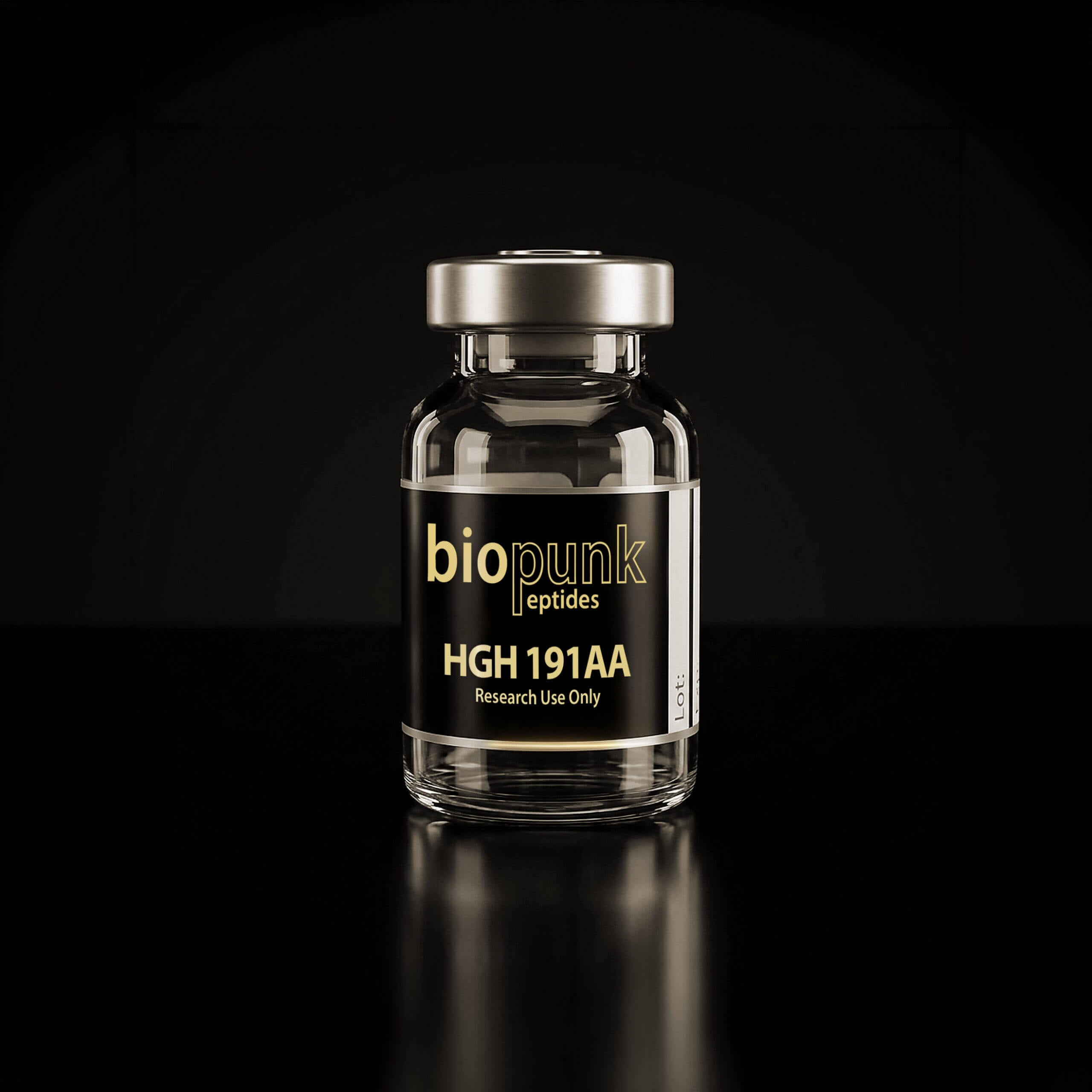
pep-HGH-15iu-us
HGH 191AA (somatropin) is a recombinant 191-residue polypeptide matching the sequence of endogenous human growth hormone. Cunningham et al. (Science, 1991; PMID 1948064) used crystallography and calorimetry to characterize how the hormone engages two sequential receptor-binding sites, driving the dimerization studied as central to downstream signal transduction. Sold research-grade, for laboratory use only. For Research Use Only. Not for human consumption.
For laboratory research use only · Not for human or veterinary use.
Description
HGH 191AA (somatropin) is produced by recombinant DNA technology and matches the 191-residue sequence of pituitary-derived human growth hormone. Structural biology research has characterized how a single hormone molecule engages two receptor-binding sites in sequence — first a high-affinity contact, then a second, lower-affinity contact — driving receptor dimerization. Just as a single signal can trigger a two-stage mechanical latch, a single somatropin molecule is studied for its capacity to bring two receptor molecules together before intracellular signaling begins.
Cunningham, Ultsch, De Vos, Mulkerrin, Clauser, and Wells (Science, 1991; PMID 1948064) used crystallography, size-exclusion chromatography, and calorimetry to characterize the 1:2 complex formed between the hormone and the extracellular domain of its receptor-binding protein, identifying two distinct, sequentially engaged binding sites and proposing hormone-induced receptor dimerization as central to signal transduction. Pearce, Ultsch, Kelley, de Vos, and Wells (Biochemistry, 1996; PMID 8756685) extended this structural work with mutational analysis of contact residues at the hormone-receptor interface, examining how buried but functionally inert side chains influence the thermodynamics of binding without altering global receptor structure. Sawada, Arai, Jing, Miyajima, Frank, and Sakaguchi (PLoS One, 2017; PMID 28686668) examined the molecular interactions among the growth hormone receptor, Janus kinase 2, and STAT5B, mapping how receptor activation propagates through downstream kinase and transcription-factor complexes in cultured cell systems.
For Research Use Only. Not for human consumption.
Specifications
Shipping & Storage
Shipping
Orders ship within 24 hours. Delivered via USPS Priority or standard FedEx unless expedited shipping is selected at checkout. Tracking is emailed on dispatch and mirrored in your account.
In-transit handling
Lyophilized vials are shelf-stable and ship at ambient temperature. Storage in our warehouse is cooled; shipment does not require refrigeration.
Long-term storage
Lyophilized vials are shelf-stable at ambient temperature; refrigeration (2–8°C) extends shelf life. Refer to the batch-specific Certificate of Analysis for material-specific storage guidance. Once reconstituted, follow the storage instructions on the batch COA. Not for human or animal consumption.
Returns
Because these are research-grade biologics, we cannot accept returns on opened vials. Damaged-in-transit shipments are replaced at no cost within 7 days of delivery.
Frequently asked
Related